


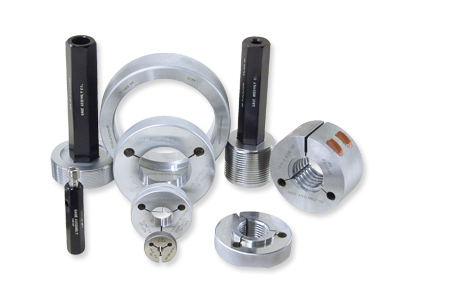
In any manufacturing process involving threaded components—bolts, nuts, threaded holes, tappet threads—the inspection of those threads is a critical control point. Using thread gauges correctly ensures you are making the right “attribute” decision: the part either meets the specification or it doesn’t. But simply handing a thread plug or ring gauge to an operator and expecting perfect results is risky. Today, we’ll walk through a systematic approach to proper usage of thread gauges, covering selection, setup, inspection technique, maintenance and calibration links to quality systems.
1. Select the correct gauge for the job
First and foremost: ensure you are using the right type of gauge for your threaded feature. There are two complementary styles:
Thread plug gauges (Go/No Go) for internal threads (nuts, tapped holes)
Thread ring gauges (Go/No Go) for external threads (bolts, studs)
Quality Magazine:
https://www.qualitymag.com/articles/94425-thread-basics-go-no-go-acceptance
Here are key selection pitfalls:
Matching the specification on the drawing exactly: thread size, series, class of fit (e.g., 2A/2B or 3A/3B) must correlate with the gauge you use. Using a 3B-class ring gauge on a 2A external thread is incorrect and can lead to bad parts passing or good parts rejected.
CrossCo:
https://www.crossco.com/resources/articles/mistakes-to-avoid-thread-gages
Understanding the difference between setting gages and working/wear check gages. Setting plugs or ring masters are calibrated to master standards and are not designed for production checking—they should not be used in place of a working Go or No-Go member.
CrossCo:
https://www.crossco.com/resources/articles/mistakes-to-avoid-thread-gages
Ensuring the gage reaches the required depth of thread in the part. For example, No-Go members must engage the thread for the correct number of turns (often 2½–3 turns) to validate size across length; if your part is shorter, you may need a special gage.
Quality Magazine:
https://www.qualitymag.com/articles/94425-thread-basics-go-no-go-acceptance
Matching materials and wear characteristics: if you’re gauging a hard material part, a standard tool-steel gage may wear prematurely and lead to mistaken acceptance. As one article advises: consider chrome‐plated or carbide gages for high usage/hard parts.
CrossCo:
https://www.crossco.com/resources/articles/mistakes-to-avoid-thread-gages/
2. Prepare the environment, instrument and part
Even the best gauge can give erroneous results if environmental, usage or handling conditions are sub-optimal. Key steps include:
Confirm that both the part and the gauge are at the calibration reference temperature (commonly 20 °C / 68 °F). Thermal expansion between the part and the gage can cause false rejects or false accepts.
https://elsmar.com/elsmarqualityforum/threads/controlled-environment-environmental-requirements-for-calibrations.16424
Clean the gage and the part: remove chips, burrs, lubricant residue, corrosion or debris that could interfere with thread engagement. A dirty or damaged thread surface can mask a size error.
Apply a thin film of appropriate lubricant on the gage to reduce friction and avoid galling, particularly for long threads or high-volume usage.
Inspect the gage for signs of wear, damage, chips or nicks before use. A gage with worn threads may incorrectly accept out-of-tolerance parts.
Make sure the part is properly fixtured/stabilized and aligns with the axis of the gauge insertion to avoid skewing the engagement or seating of the Go/No-Go feature.
3. Perform the inspection correctly
When you’re ready to inspect, follow a consistent method and record results (as applicable) for traceability.
Go member (should fit):
Insert or run the Go end of the gage with controlled hand force (avoid excessive torque or mechanical drive). The Go should engage fully to the depth required (or until the stop feature). If it does not fully enter, the thread is too small or not deep enough.
Quality Magazine:
https://www.qualitymag.com/articles/94425-thread-basics-go-no-go-acceptance
For internal threads, insert the Go plug and wind carefully—avoid forcing. For external threads, screw on the Go ring until it seats.
No-Go member (should not fit):
After the Go passes, attempt the No-Go. It must not fully engage beyond the allowed number of turns (commonly 2½–3 complete turns) or thread depth. If it does, the feature is too large or oversize.
Quality Magazine:
https://www.qualitymag.com/articles/94425-thread-basics-go-no-go-acceptance
Record the result: pass or fail. Ensure the decision point is clear: if Go passes and No-Go fails → part acceptable. Any other result → reject.
4. Review and interpret results
It’s important to treat this as an attribute gage decision—Go/No-Go is not providing you a dimension; it’s giving a “yes/no” outcome.
Walden Gage Calibration Services:
https://www.foxvalleymetrology.com/blog/thread-inspection-101-part-i-thread-gage-basics
Some additional considerations:
If many rejections occur, check the gauge (for wear/damage), check the process (machining, tapping, plating shrinkage) and confirm correct specification.
Periodically verify gage performance against a master or reference standard—even though the operator performs Go/No-Go, the gage itself must be verified in the calibration program.
Keep in mind that uncertainty of the measurement chain (including gage wear, environmental drift, operator variation) must be considered, especially when tolerances are tight. In some cases, measurement uncertainty may be a significant fraction of tolerance.
Quality Magazine:
https://www.qualitymag.com/articles/95656-dealing-with-measurement-uncertainty?
Record inspection data, traceability log of gages, calibration status, and any deviations—for internal audit and for linking to your accredited calibration system (e.g., ISO/IEC 17025).
5. Maintenance, calibration and lifecycle of thread gauges
Proper care and maintenance extend the life of your gauges and support your quality system. Consider the following:
Regular cleaning and protective coating (oil, wax film) after use, especially in humid or corrosive environments.
Store thread plug and ring gauges in protective cases or racks to avoid impact, deformation or contamination.
Inspect gages periodically: look for wear on Go ends (which typically wear faster) and on No-Go seating ends. Replace or re-calibrate when wear is evident.
Schedule calibrations at intervals based on usage, tolerance criticality, environment and history of wear. Some references indicate that for gages in heavy use or hard material parts, calibration and inspection frequency should increase.
Cutwel:
https://www.cutwel.co.uk/blog/thread-gauge-calibration?
Choose a calibration laboratory that is ISO/IEC 17025-accredited and has traceability to national standards. This ensures that your calibration results are accepted internally and externally, and you maintain the measurement traceability chain.
Document calibration certificates, gage identity, calibration interval, results including measurement uncertainty (which may be relatively large for thread gages).
Quality Magazine:
https://www.qualitymag.com/articles/95656-dealing-with-measurement-uncertainty?utm_source=chatgpt.com
6. Integrating with your quality system
From a management/quality‐systems perspective, incorporating thread gauge usage into your inspection procedure supports consistency, traceability and audit readiness:
Define a standard operating procedure (SOP) for thread gauging (selection, handling, inspection method, decision criteria, record keeping).
Train operators on correct gage usage—avoid common mistakes like forcing the gage, using the wrong class of fit, or using setting gages in production.
CrossCo
Maintain a gage log: include gage ID, size/class, calibration date, next due date, usage count (if tracked), wear history.
When changes occur (new part design, plating change, thread form change), review your gage inventory and ensure you still use the correct gauge or if a new/custom gage is required.
https://www.crossco.com/resources/articles/mistakes-to-avoid-thread-gages/
Monitor inspection results: a sudden increase in No-Go failures may indicate gage wear, process drift or incorrect gage use. Use this as a trigger for root-cause action.
Link the gage maintenance and calibration schedule to your quality system documentation (for example, referencing that your calibration provider is ISO/IEC 17025-accredited and maintains traceability). This links back to your audit readiness and continuity of measurement assurance.
Conclusion
Correct use of thread gauges is more than just handing them to an operator: it involves selecting the right gauge, setting up the environment and part, following a consistent inspection method, ensuring gage integrity and calibration, and embedding the process in your quality system. For manufacturers of threaded parts, these steps reduce risk, support measurement confidence, and improve production consistency. When your thread gages are well-managed and your operators well-trained, the Go/No-Go decision becomes a strong pillar of your inspection strategy rather than a weak link.